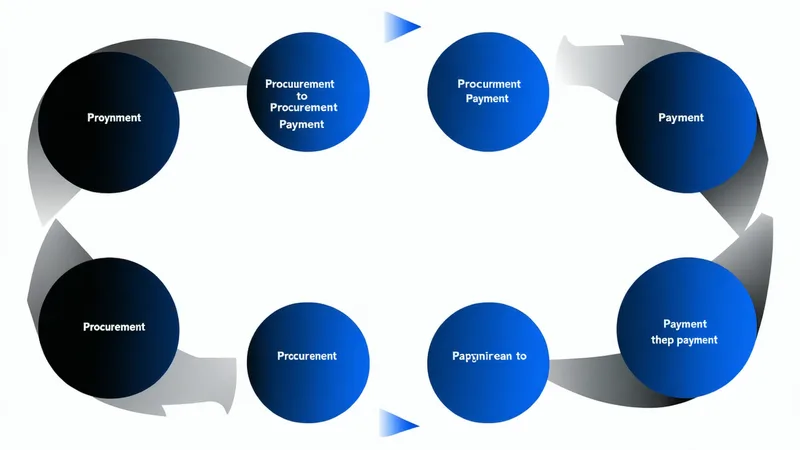
The procure-to-pay process is the full operational chain from the moment someone in your organization decides to buy something to the moment the supplier is paid. It spans procurement, receiving, AP, and treasury. And in most mid-market companies, it's managed by three to four different teams with different systems, different priorities, and limited visibility into what the others are doing.
AP automation addresses the AP portion of this chain well. But teams that limit their optimization focus to AP in isolation often find that their automation investment delivers less than expected — because the bottlenecks have moved upstream. The AP team is processing invoices faster, but the exception rate is still high because purchasing isn't creating POs before ordering. Or the invoice cycle time has improved, but early payment discounts are still being missed because the approval workflow is still routed through a department hierarchy rather than directly to budget owners.
P2P optimization requires treating the full chain as a single system, even if different parts of it are owned by different people.
The Four Stages of the P2P Cycle
The procure-to-pay cycle has four discrete stages, each with its own process risks and improvement levers:
Stage 1: Requisition and Purchase Order (Procurement). Someone in the organization identifies a need and either submits a purchase requisition or directly creates a purchase order (depending on your procurement policy). The PO gets approved, assigned a PO number, and sent to the supplier. This stage is where spend control lives: is every purchase going through an approved PO process? Are PO amounts accurate relative to what's actually being ordered?
Stage 2: Goods and Services Receipt (Operations/Receiving). The supplier delivers goods or completes services. Someone in the receiving function confirms delivery, records the quantities and conditions received, and creates a goods receipt (GR) or delivery confirmation in the ERP. This stage is where the third leg of three-way matching originates. If GRs aren't created promptly or accurately, AP can't match invoices.
Stage 3: Invoice Processing (Accounts Payable). The supplier submits an invoice. AP captures it, matches it against the PO and GR, codes it to the correct GL account, routes it for approval, and releases it for payment once approved. This is the stage where AP automation has the most direct impact.
Stage 4: Payment and Settlement (Treasury/AP). Approved invoices are scheduled for payment, the payment is executed via ACH, wire, or virtual card, and the ERP records are updated. Supplier receives payment and applies it to their receivables.
Most P2P problems that show up as AP exceptions actually originate in Stage 1 or Stage 2. Fixing Stage 3 without addressing Stage 1 and Stage 2 is the AP equivalent of treating symptoms without addressing the underlying condition.
Stage 1 Failures: The PO Discipline Problem
Maverick purchasing — buying without an approved purchase order — is the single largest driver of AP exception volume in most mid-market organizations. Invoices arrive with no PO reference, and AP either has to track down the purchase history (time-consuming) or route the invoice to a department head for after-the-fact approval (slow, imprecise, and a controls failure).
The fix isn't better AP software — it's purchase order discipline enforced at the procurement stage. Three interventions that consistently reduce maverick purchasing:
PO-required policy for all purchases above a threshold. Set a dollar threshold (commonly $500–$1,000 for services, $250 for goods at companies with high invoice volume) below which invoices can be approved without PO matching, and above which PO-backed invoices are required. Enforce this policy by routing non-PO invoices above the threshold to the CFO's attention with a specific "missing PO" flag — a visible consequence for departments that routinely bypass the PO process.
Supplier communication about PO requirements. Many suppliers don't include PO numbers on invoices because nobody has told them to. A clear supplier communication — "All invoices must include a valid PO number. Invoices without a PO number will be held for resolution" — combined with a supplier portal that validates PO numbers at submission, eliminates a significant portion of the no-PO exception category at the source.
PO price accuracy as a procurement discipline metric. Track PO-to-invoice price variance by department and by purchasing agent. Departments with chronic price variance exceptions on their POs have a purchasing discipline problem: they're creating POs with estimated prices that don't match contracted rates, or not updating POs when suppliers change pricing. Visibility into this metric at the department level creates accountability that AP cannot create on its own.
Stage 2 Failures: GR Timing and Accuracy
Three-way matching can't happen until a goods receipt exists in the system. In many mid-market companies, GR creation lags the actual delivery by days — sometimes weeks — because receiving staff are entering GRs in batches, or because the ERP's receiving module requires access credentials that not everyone in the warehouse has, or because the process for confirming service delivery is undefined.
A professional services firm processing approximately 1,400 invoices per month found that 38% of their AP exceptions were timing exceptions — invoices received from service vendors before the project manager had confirmed delivery in the ERP. Their AP team was holding these invoices in a manual queue while chasing project managers for delivery confirmation. The fix wasn't AP-side: it was implementing a digital delivery confirmation workflow for project managers, with a 48-hour SLA from service completion to ERP confirmation, and automated escalation to the project director if confirmation wasn't recorded in time.
That single process change — earlier, more disciplined GR creation — reduced their exception rate by 14 percentage points without any changes to AP software or staffing.
The Role of the Supplier Portal
A supplier self-service portal sits at the intersection of Stage 1 and Stage 2 for services invoices, and at Stage 3 for invoice submission. When implemented well, it shifts substantial process work to the supplier:
- Suppliers submit invoices through the portal rather than by email or mail, with field validation that prevents missing PO numbers, incorrect tax IDs, or improperly formatted amounts at the source
- Suppliers can view their own invoice status — matched, approved, payment scheduled, paid — without calling AP
- Suppliers can update their own banking information subject to an approval workflow, reducing ACH return rates
- Suppliers can submit delivery confirmations or proof-of-service documents directly tied to the invoice, reducing GR delay for services spend
Supplier portal adoption requires deliberate onboarding effort — suppliers don't automatically switch from emailing invoices to a PDF to using a portal. The adoption investment pays off most quickly on high-frequency suppliers (50+ invoices per year) and suppliers with high invoice complexity. For occasional vendors with simple, low-value invoices, email submission with OCR capture is often sufficient.
Aligning Procurement, Receiving, and AP Around Shared Metrics
The organizational challenge in P2P optimization is that the three functions involved — procurement, operations/receiving, and AP — typically have different managers, different performance metrics, and different incentives. Procurement is measured on cost savings and supplier contracts. Operations is measured on delivery performance and warehouse throughput. AP is measured on invoice cycle time and payment accuracy.
None of those metrics individually incentivize the cross-functional behaviors that P2P optimization requires: procurement creating accurate POs that match actual orders, receiving confirming deliveries promptly and accurately, AP processing invoices within discount windows.
The shared metric that aligns all three is end-to-end P2P cycle time: from invoice receipt date to payment date, for invoices that arrived with a valid PO reference and a confirmed GR. This metric is measurable, everyone's behavior affects it, and it's directly connected to the financial outcomes (early payment discounts, vendor relationship quality, working capital management) that the CFO cares about.
Technology Doesn't Fix Process Problems
We're not saying AP automation is insufficient — it's a necessary component of P2P optimization at mid-market scale. The point is that it's not sufficient on its own. Organizations that deploy AP automation without addressing PO discipline, GR timing, and supplier onboarding often find their exception rate stubbornly high because the root causes are upstream of the AP tool's visibility.
The companies that get the most from AP automation investment are those that treat the deployment as an opportunity to rethink the full P2P process — not just the AP portion of it. They use the automation project as the trigger for the procurement policy update that's been overdue for three years, the supplier communication that nobody got around to sending, and the metrics conversation with Operations about GR timeliness.
The technology is the forcing function for the process work. The process work is what makes the technology actually deliver its expected value. Neither operates well without the other.