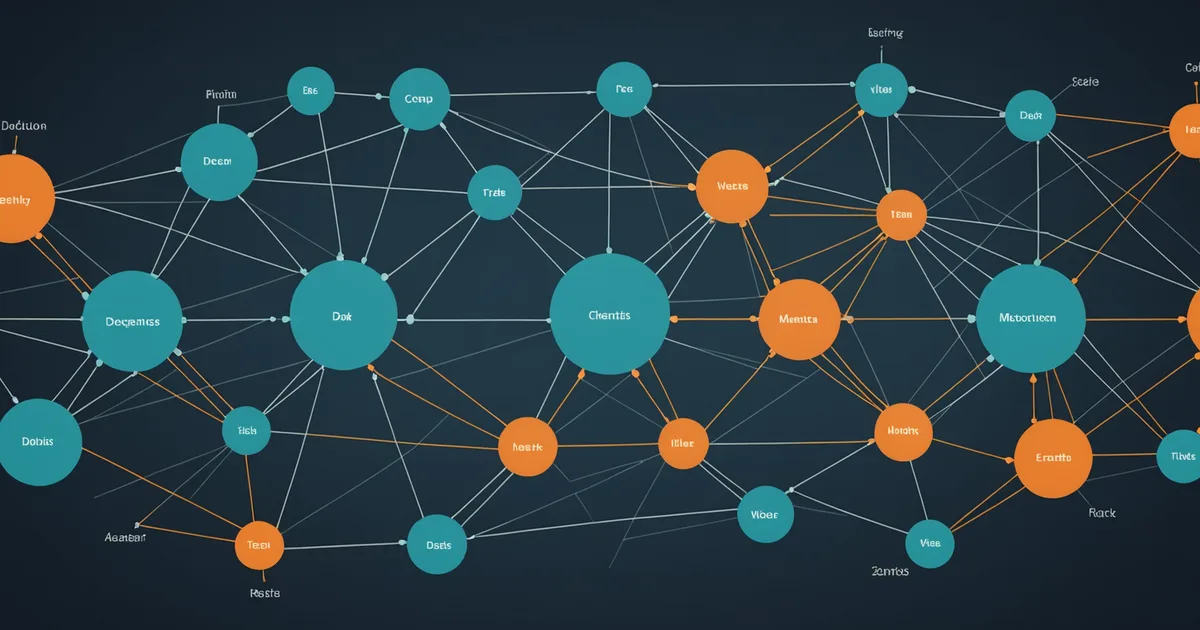
Most procurement risk programs are built around a reasonable premise: know your suppliers, qualify them, score them, and review them periodically. The problem is that this framework stops at Tier 1—the vendors on your purchase orders—and the supply chain doesn't.
We built Apvyne specifically because this Tier-1 boundary creates a visibility blind spot that accounts for a disproportionate share of actual supply disruptions. The suppliers you contract with directly are, in most cases, the ones you understand best. The risk lives below them.
The Tier-1 Illusion of Control
When a procurement team builds out its supplier qualification process, it typically covers: financial health of direct vendors, on-time delivery performance, quality certifications, and geographic concentration at the Tier-1 level. All of that matters. But it creates an implicit assumption that if your direct supplier is healthy, your supply path is safe.
That assumption breaks down the moment your direct supplier shares a critical sub-component source with three other manufacturers you also buy from. The concentration risk is real and measurable—it just doesn't appear in any Tier-1 scorecard because your Tier-1 vendors each look independent from your vantage point.
Consider the electronics supply chain. A mid-size industrial equipment manufacturer might have contracts with four separate contract manufacturers for different product lines. Each CM is qualified, audited, and performing to spec. But if all four share the same specialty capacitor supplier in the same region, the "diversified" CM portfolio is carrying a hidden single-source dependency. None of the CMs volunteered that information. Nothing in a standard SRM platform would surface it.
Why Tier-2 Data Is Structurally Hard to Get
There are structural reasons why sub-tier data doesn't flow up to procurement teams. Contract manufacturers treat their supplier networks as proprietary information—it's part of their competitive advantage. They may also have contractual restrictions that limit what they can disclose about their sub-suppliers.
Even when CMs are cooperative, their own BOM data may not be well-organized for sharing. Sub-tier supplier names may be inconsistent across internal systems, partially anonymized in data exports, or simply not tracked at a granularity useful for concentration analysis.
The result is that most procurement teams don't lack the will to monitor Tier-2 risk—they lack the data infrastructure to do it. Manual surveys of CMs are slow, incomplete, and often answered at whatever level of detail the CM is comfortable sharing, not the level of detail the procurement team actually needs.
Where Disruptions Actually Start
Industry post-mortems on supply chain disruptions are instructive. The 2011 Thailand floods disrupted hard drive production globally—not because major manufacturers were hit, but because specific component suppliers concentrated in the affected region supplied multiple major manufacturers simultaneously. The disruption propagated up through Tier-1 relationships that had no visibility into the shared sub-tier dependency below them.
The same pattern repeats in semiconductor supply chains, specialty chemicals, and precision machining. The event that triggers the disruption happens at Tier 2 or Tier 3. It reaches Tier 1 quickly. By the time it reaches your organization, lead time to respond is measured in weeks, not months.
We're not saying Tier-1 risk monitoring is irrelevant—it absolutely isn't. Direct supplier financial health, delivery performance, and compliance status all matter. But these signals rarely give you advance notice of a sub-tier event. A healthy Tier-1 supplier can fail to deliver because their sub-supplier failed, and neither the scorecard nor the audits predicted it.
The Concentration Multiplier Effect
What makes sub-tier concentration risk particularly dangerous is the multiplier effect. A single Tier-2 supplier failure doesn't just disrupt one of your supply paths—it disrupts every supply path that routes through that node, including ones you may not have known were connected.
Imagine a procurement team that has spent years diversifying their CM base across four vendors in three geographies, confident they've eliminated concentration risk at Tier 1. A sub-tier mapping exercise reveals that three of those four CMs source a critical PCB sub-assembly from the same two suppliers. The geographic diversification at Tier 1 is real, but it's largely irrelevant if a Tier-2 event can knock out 75% of production capacity simultaneously.
The concentration multiplier means that sub-tier risks often have a worse expected impact than they first appear. The probability of any given Tier-2 supplier having a significant disruption in a given year is relatively low. But the impact when it happens—given that it simultaneously affects multiple Tier-1 paths—is far higher than a single-supplier disruption at the Tier-1 level.
What a Tier-2 Risk Program Actually Requires
Getting meaningful Tier-2 visibility requires solving three problems that most procurement teams don't currently have infrastructure for.
First, you need structured BOM data that extends beyond your direct purchase relationships. This means either working with your CMs to extract their supplier data or using external network data sources that can infer sub-tier relationships from public and aggregated supply chain disclosures.
Second, you need a way to normalize supplier identities across data sources. The same sub-tier supplier may appear under different legal entity names, parent company names, or DBA variants across different CMs' data exports. Without entity resolution, your concentration analysis will undercount the actual overlap.
Third, you need a risk scoring methodology that accounts for concentration across your entire supply base—not just per-supplier scores. A sub-tier supplier that provides components to 5% of your supply base is low-concentration. One that touches 60% of your supply base through multiple Tier-1 relationships is a critical single point of failure, regardless of how financially healthy it is.
Where to Start
The most practical starting point for most procurement teams isn't a full Tier-2 mapping exercise across their entire supply base. It's a focused risk assessment on their highest-spend or highest-criticality supply paths.
Pick the ten product lines or categories where a production disruption would have the most severe financial impact. Map those BOM paths as far as you can through your direct CM relationships. Even a partial map often reveals concentration patterns that weren't visible at Tier 1—and it creates a baseline for expanding coverage over time.
The goal isn't perfect visibility across every sub-tier node. It's knowing enough to identify your ten highest-concentration risk paths so you can start making sourcing decisions that actually reduce your exposure rather than just your visible Tier-1 supplier count.
Procurement teams that have done this work consistently report the same reaction: the concentration patterns they find are not what they expected, and the diversification strategies they were pursuing at Tier 1 were addressing the wrong level of the problem.